











 |
| Gold V.1.3.1 signal Telegram Channel (English) |

US November CPI Plunges to 2.7%: Fed Rate Cut Repricing Hammers Dollar, Gold Holds Near Record Highs
2025-12-19 @ 01:24
US Inflation Data Delivers Major Cooling: Core CPI Hits Lowest Since March 2021, Reshaping Fed Policy Path
The US Consumer Price Index report released on December 18, 2025, presented a significant downside surprise well below market expectations, with headline inflation cooling to 2.7% year-over-year—substantially below the 3.1% consensus forecast. More critically, core inflation fell to 2.6%, marking its lowest level since March 2021 and settling far below the expected 3.0%. This data point not only provides the Federal Reserve with policy flexibility but has triggered pronounced repricing across global major asset classes, currencies, and commodities.
Key Data Breakdown: Special Calculation Method Due to Government Shutdown
Due to the government shutdown disrupting data collection, the Bureau of Labor Statistics implemented an unprecedented technical adjustment in the November CPI report, aggregating September-November data over a two-month period rather than using standard monthly comparisons. While this methodological adjustment introduces some ambiguity about data purity, the magnitude of the gap between actual results and market expectations remains economically significant.
Headline Inflation Metrics:
- Year-over-Year: 2.7%, down from 3.0% in September
- Month-over-Month: November standalone data unavailable due to government shutdown technical constraints
- Energy Component: Rose 1.1% over the September-November two-month period
- Food Component: Rose just 0.1% over the same period
Core Inflation Metrics:
- Year-over-Year: 2.6%, down from 3.0% in September
- Two-Month Period Month-over-Month: 0.2%
- Shelter Costs: Increased just 0.2% over the two-month period, significantly below earlier-year gains
Citigroup economist Veronica Clark noted that November CPI data could “more heavily capture holiday season discount effects than typical November pricing dynamics,” potentially creating an unusually low baseline. Nevertheless, the 40-basis-point drop in core inflation year-over-year from September to November, combined with shelter cost deceleration, still validates the Fed’s September-December rate-cutting cycle and suggests the disinflationary process has not yet exhausted its momentum.
Economic Implications of Cooling Inflation: Soft Landing or Demand Collapse?
This CPI report carries profoundly contradictory signals for US economic prospects. On one hand, easing inflation pressure without triggering severe recession validates the Fed’s two-year monetary tightening “soft landing” objective. Consumer purchasing power is stabilizing, and the Fed gains credibility for cutting rates without reigniting inflation.
However, inflation cooling is occurring simultaneously with sharp labor market deterioration. Employment data released December 16 showed just 64,000 nonfarm payroll additions in November, far below market expectations of 100,000+, with the unemployment rate climbing to 4.6%—the highest in over a year. This combination suggests the economy may be cooling faster than headline growth statistics indicate, with demand destruction (driving lower inflation) potentially outpacing supply-side improvements.
The University of Michigan consumer sentiment survey showed consumers raising inflation expectations to 3.3% despite today’s data, likely reflecting concerns about the Trump administration’s tariff agenda. This disconnect between hard spending data and forward-looking sentiment could unwind rapidly if consumers begin preemptively reducing purchases in anticipation of tariff-induced price increases in 2026.
Fed Policy Pivot: The End of “Higher for Longer” Narrative
This CPI report fundamentally reshapes the Fed’s 2026 policy outlook. The Fed just completed its December 10 meeting, cutting rates by 25 basis points to the 3.50%-3.75% range. While a January 2026 rate cut remains unlikely (meetings typically space six weeks apart), the dovish tilt has clearly shifted. Futures markets, which priced only ~20% odds of a January cut before today’s data, will likely reassess significantly upward.
Medium-Term Outlook (Q1-Q2 2026): Markets are now repricing for renewed rate cuts beginning March 2026, with expectations for two or more cuts through mid-year. The previous “higher-for-longer” narrative has collapsed—the Fed’s December dot plot projected just two cuts in 2026, but this guidance now appears insufficiently dovish relative to incoming inflation data.
The December 10 FOMC statement deliberately added language about “the extent and timing” of future rate adjustments, signaling caution about the cutting pace. This hawkish twist reflected Fed leadership concerns that inflation remained sticky and that Trump tariffs posed unquantifiable upside risks to the 2026 inflation path. Today’s CPI data partially vindicates this caution but also suggests the Fed may have overcorrected toward hawkishness.
Fed speakers have delivered mixed messages. Governor Christopher Waller indicated that policy may need to normalize (cut rates) as inflation cools, while Atlanta Fed President Raphael Bostic resisted near-term cuts, demanding clearer progress. This division will likely persist through January, creating additional volatility around forward guidance.
The Trump Factor: President Trump has publicly criticized the Fed’s rate levels as “far too high.” Today’s inflation surprise will likely embolden Trump to publicly pressure the Fed for aggressive cuts, potentially creating political tension with the nominally independent central bank in early 2026.
US Dollar Trajectory: Structural Weakness Emerges
The CPI release triggered immediate and pronounced dollar weakness. The US Dollar Index (DXY) fell to the 98.20-98.30 range, hitting multi-week lows and continuing this year’s 9.5% decline—the steepest annual drop since 2017. The index has traded below its 50-day moving average, signaling lost momentum, though technical support at the 100-day SMA near 98.60 remains intact.
Softer inflation data reduces justification for sustained higher US rates. With core inflation back to 2021 levels and trending toward the Fed’s 2% target, international investors face diminished carry yields in dollar-denominated assets. The “higher-for-longer” thesis that dominated 2023-2024 has effectively expired, making USD-denominated treasuries less attractive relative to other currency alternatives.
Near-Term Outlook (Q1 2026): Dollar weakness trajectory is likely to extend through year-end 2025 and into early 2026, unless December PCE (the Fed’s preferred inflation metric) or January CPI show unexpected strength. Current market positioning suggests each new data point confirming the disinflationary narrative will provide renewed selling pressure on the dollar. However, any evidence of tariff-driven re-acceleration in inflation could quickly reverse this trend, potentially testing 99.50+ resistance levels.
Major Currency Pair Analysis: Winners and Losers
EUR/USD: Primary Beneficiary
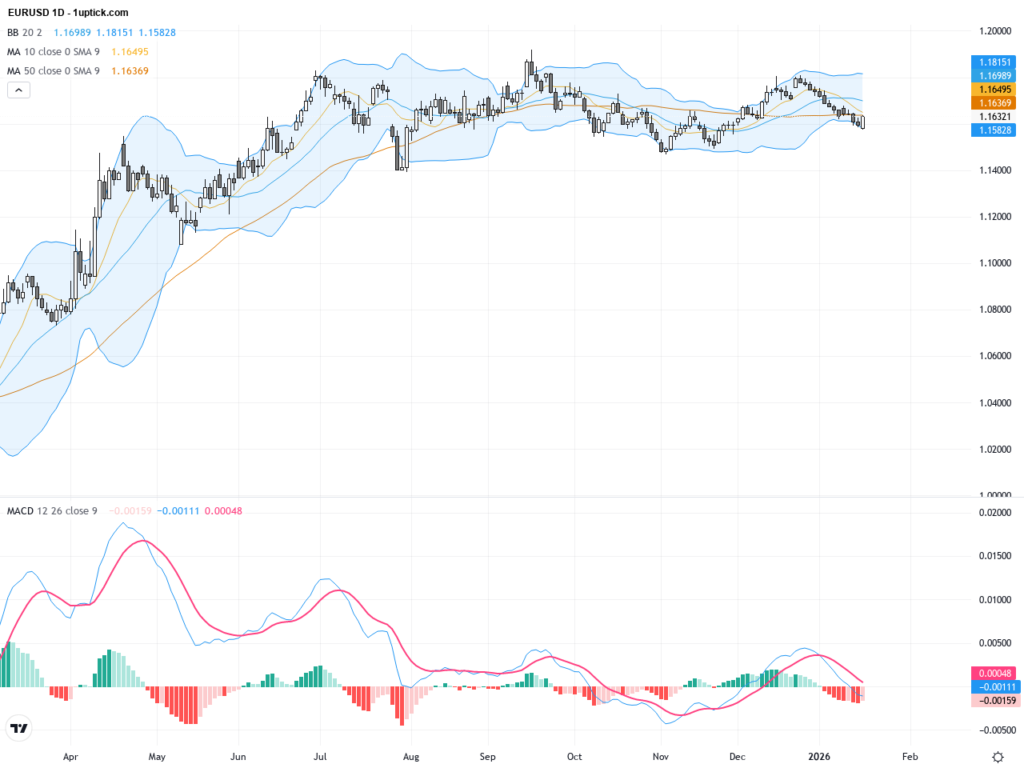
The euro surged to daily highs around $1.1750, reinforcing above the rising trendline from late November. The European Central Bank held rates steady on December 18, maintaining its patient easing bias. With the ECB now confident that eurozone inflation will normalize toward 2% by 2027-2028, the institution signaled openness to additional cuts in 2026. Weaker dollar combined with ECB easing bias creates a favorable environment for euro strength. EUR/USD could test 1.1800+ resistance in coming weeks, with medium-term support established at the 50-EMA near 1.1735.
GBP/USD: Secondary Strength
The British pound printed daily highs near $1.3440, continuing recovery from November lows. While the Bank of England has not signaled dovish repricing, sterling benefits from being a commodity-linked currency in an environment where both dollar weakness and EM recovery are occurring simultaneously. Consolidation likely near current highs as markets await BOE guidance from its December 19 meeting.
JPY/USD: Divergent Trends
The yen strengthened versus the dollar due to dollar weakness, though not dramatically—the pair moved to around 155.5-156.0 from prior levels. The Bank of Japan is simultaneously expected to raise rates (hawkish), which should support JPY, while the dollar is falling (also JPY supportive). However, if the BOJ hike disappoints or sounds dovish, yen gains could accelerate.
CAD/USD and Antipodean Currencies: Commodity Currency Divergence
The Canadian dollar weakened relative to USD, rising 0.42% on the day—an exception to broad dollar weakness. Canadian economic data has disappointed, and the Bank of Canada may face pressure to cut rates if broader EM weakness persists. The Australian and New Zealand dollars gained 0.40% and 0.27% respectively, outperforming against the weakening dollar, as lower US rates reduce the yield advantage of dollar assets, encouraging flows to higher-yielding markets.
Gold Price Action: Complex Market Response
Gold prices responded positively but cautiously to the CPI surprise, with markets weighing competing dynamics. Pre-CPI, gold traded near $4,340-4,350, consolidating from late-November highs near $4,381. Post-CPI, gold hovered near $4,340, staying close to October record highs despite the dovish CPI surprise. Gold has risen 6.83% in December and 67.89% year-over-year, reflecting the precious metal’s status as this year’s strongest-performing major asset class.
Bullish Factors for Gold:
- Lower Real Yields: The combination of softer inflation and Fed rate-cut expectations leads to lower real (inflation-adjusted) yields, making non-yielding gold more attractive
- Dollar Weakness: The 0.1% decline in the USD Index directly reduces gold’s relative cost for foreign buyers, typically adding 40-50% of gold’s gains on CPI-driven rallies
- Geopolitical Risk Premium: Elevated US-Venezuela tensions over oil sanctions, combined with ongoing Russia-Ukraine conflict, support gold’s safe-haven appeal
Limiting Factors for Gold:
- Profit-Taking: Gold had rallied 6.83% in December alone, with the five-week advance from mid-November potentially vulnerable to consolidation
- Fed Caution: While the CPI surprise is dovish, Fed officials remain cautious about committing to sustained rate cuts, given data quality concerns from the shutdown and tariff uncertainties
- Inflation Risk Reversal: If tariff passthrough occurs in coming months (December-February), inflation could re-accelerate, forcing the Fed to pause rate cuts or potentially raise rates in mid-2026
Gold consolidation near $4,340 reflects a market that has priced in modest Fed easing but remains uncertain about 2026 policy consistency. Key support is at $4,281 (50-EMA), with resistance at $4,385 and psychological resistance at $4,400.
Year-End Outlook: Gold is likely to remain bid near-term ($4,350-4,400 range) on seasonal year-end positioning and geopolitical risks, with potential to test October’s record highs ($4,381) if Fed rate-cut expectations accelerate. However, a break above $4,400 would require either a Fed rate-cut announcement or significant new geopolitical escalation.
Global Economic Implications: Deflationary Shock Spillovers
Emerging Markets: Currency and Policy Relief
Emerging market currencies have been under sustained pressure from elevated US rates. The softer US inflation profile reduces justification for the Fed’s higher-for-longer stance, allowing EM central banks to ease monetary policy without fearing currency depreciation from rate differentials. This is particularly important for countries like Mexico, Brazil, and India, where domestic inflation pressures remain elevated but currency depreciation had limited policy options.
China: Ambiguous Impact
China faces a deflationary environment domestically (core inflation at 0.7% year-over-year in November) while simultaneously experiencing strong export growth on potential tariff-driven redirection. Softer US inflation data suggests lower US demand going forward, which could reduce export growth momentum for Chinese manufacturers. However, the reduced Fed rate path may reduce pressure on the yuan, supporting asset prices and financial stability.
Europe: Easing Cycle Confirmed
The ECB can now proceed with confidence on its easing cycle, with the December 18 statement reaffirming data-dependent flexibility for 2026 rate cuts. Core eurozone inflation at 3.0% has cooled to near-target levels, removing the last justification for the ECB’s hawkish hold. Expect the ECB to cut rates in March 2026 and potentially again in June, supporting European growth but also pressuring EUR/USD from a carry perspective.
Global Trade: Stagflation Risk Reduced
The combination of softening US inflation and clear Fed easing bias reduces the immediate risk of a “global stagflation” scenario (high inflation + low growth). However, this relief comes with a caveat: Trump’s tariffs remain a wild card that could trigger re-acceleration in US inflation and spark retaliatory measures from China, the EU, and others. The current benign inflation backdrop may be temporary, creating false confidence that could be shattered by policy surprises in early 2026.
Critical Caveats for Investors
Data Quality Risk: The government shutdown created an unprecedented data gap. The BLS-implemented technical two-month methodology is suspected by analysts of potentially biasing inflation downward. December CPI release (January 13, 2026) and January CPI (February 12) will be crucial confirmation. A reacceleration in either print would dramatically shift this dovish narrative.
Tariff Wild Card: The Trump administration’s tariff plans remain largely unpriced in commodities and import-sensitive sectors. A 10-25% across-the-board tariff implementation in Q1 2026 could trigger a 1-2 percentage point increase in inflation by mid-2026, fundamentally altering the Fed’s rate path and currency flows.
Unemployment Threshold: While inflation is cooling, unemployment is rising. If the jobless rate reaches 5.0% or higher in the next two months, the Fed will face intense pressure for aggressive cuts (50 bps) regardless of inflation concerns. This would represent a policy regime shift toward “put” protection of the labor market.
The November 2025 CPI report marks a pivotal shift from an inflation-fighting paradigm to a growth-protection paradigm for the Federal Reserve. With core inflation now below 3% and trending toward the 2% target, the central bank has demonstrated success in its tightening campaign, even at the cost of visible labor market deterioration. For global investors, this creates a favorable environment for currency diversification away from the dollar, EM asset accumulation, and moderate gold/commodity exposure. However, the tariff wild card and data quality concerns warrant caution about extrapolating this dovish trend too far into 2026.