


 |
| Gold V.1.3.1 signal Telegram Channel (English) |
Trump’s Economy: You’re Either an Insider or a Chump thebulwark.com
2026-04-10 @ 08:58
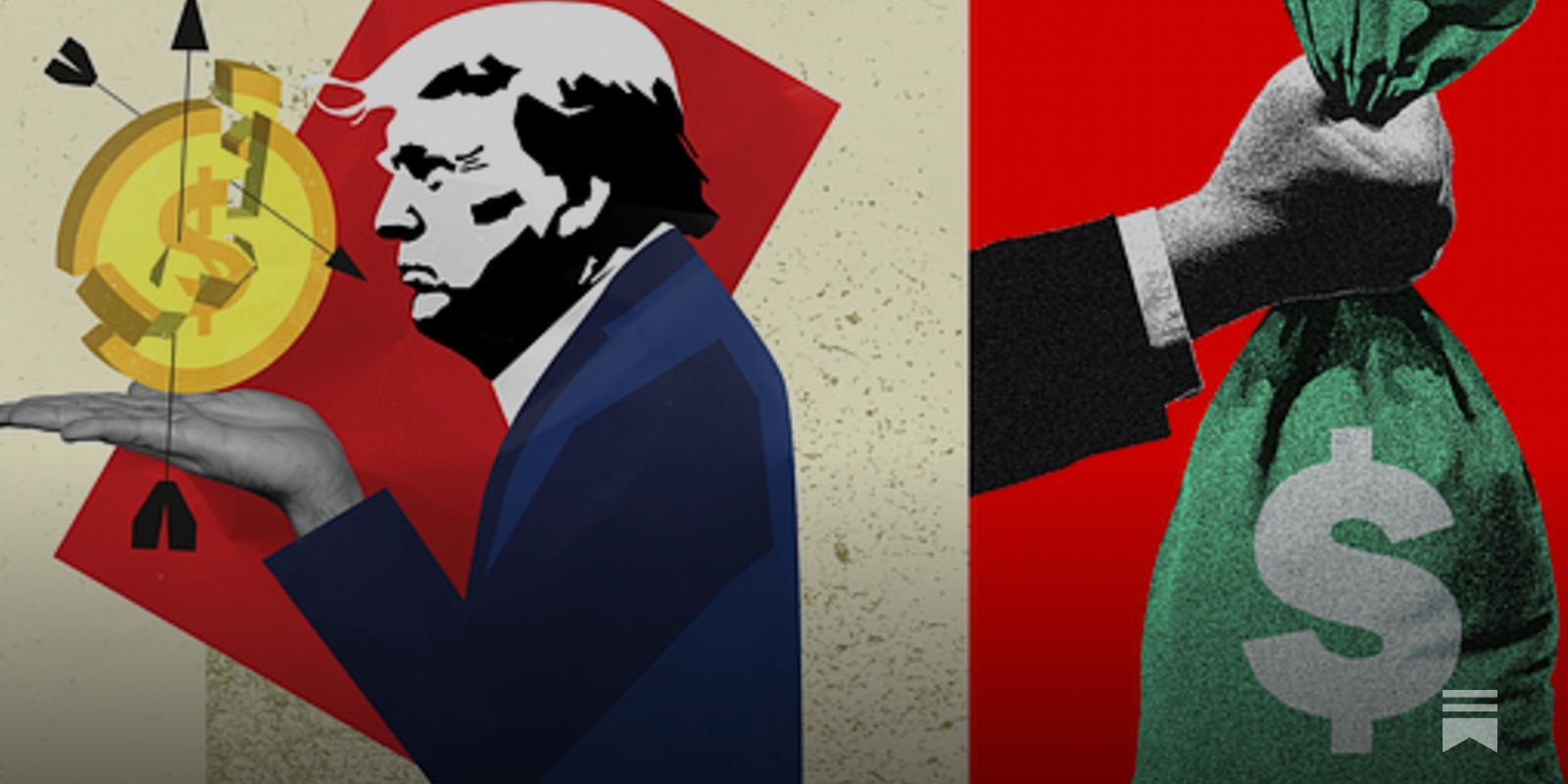
A LOT OF PEOPLE ARE GETTING RICH off the Trump presidency. Donald Trump himself tops the list, of course, but it also includes his kids and in-laws; other grifting nepo-babies; cabinet members (as well as their staff and children), senior aides; and other well-connected friends, investors, and firms.
You know who isn’t on that list?
You.
Yes, you, dear reader—at least assuming you’re not among the small community of courtiers sucking public funds dry. Instead, in virtually every way imaginable, Trump has made it easier for all those insiders to profit and, in turn, rip you off. If you bet on or invest in anything Trump might influence and you don’t have inside information, you’re a chump.
As the expression goes: If you’re not at the table, you’re on the menu.
Keep up with all our newsletters, articles, podcasts, and livestreams—and decide which ones show up in your inbox:
Join
The recent rash of curiously well-timed trades in prediction markets is one example of how those who have drawn up chairs to Trump’s banquet table appear to be feasting at public expense.
For example, there was the Polymarket account that banked over half a million dollars by betting on Iran strikes and the, ahem, departure of the ayatollah shortly before our military started dropping bombs. Other ‘lucky’ betting-market accounts, created right before the United States invaded Venezuela, engaged only in Venezuela-related bets, and somehow made perfect predictions every time, the Financial Times reported.
Similarly, just this week, a group of newly created Polymarket accounts “made highly specific, well-timed bets on whether the U.S. and Iran would reach a ceasefire on April 7,” Politico found.
These kinds of trades have raised concerns about not only insider-trading based on confidential or classified information, but also the incentives they create for as-yet-unmade decisions. How do we know officials are crafting policy based on what’s best for the national interest rather than what produces the biggest payday?
The risk of public fleecing based on private (or classified) data is not unique to prediction markets. There has been suspicious trading activity in more traditional financial markets, too.
Last month, minutes before Trump posted a market-moving post about his supposedly “productive” talks with Iran, someone (or someone_s_, or some entity) placed bets worth half a billion dollars in oil markets.
“My gut from watching markets for the last 25 years is this is really abnormal,” a portfolio manager told the FT. “It’s Monday morning, there’s no important data today, there aren’t any Fed speakers you’d want to front run. It’s an unusually large trade for a day with no event risk. . . . Somebody just got a lot richer.”
This kind of insider trading is not some victimless crime. When traders front-run a market-moving Trump post, or a military announcement, or some other confidential or classified information, they’re taking money from all the other investors who didn’t have access to that inside information. Put another way: They’re taking money from your 401(k). Or your teachers’ pension funds. Or mom-and-pop investors. Again, all the chumps and suckers who don’t have a direct line to the president.
Join our growing pro-democracy community
Less white-collar enforcement, more eligible white-collar victims
OF COURSE, INSIDER TRADING antedates the Trump administration and has produced its fair share of political scandals in the past. But at least historically federal law enforcement usually tried to crack down on it, along with other white-collar crimes. That is . . . somewhat less true today.
Now, in fairness, Justice Department white-collar prosecutions have been trending downward more or less since the 1990s, with occasional spurts of enforcement (such as right after the 2008 financial crisis). But the Trump administration just hit an all-time low in white-collar prosecutions this past fiscal year, according to data from the Transactional Records Access Clearinghouse.
The Trump administration has dropped 145 major enforcement actions against corporations that it inherited from the Biden administration. And under Trump the head of the Department of Justice criminal division issued a directive last year to turn “a new page on white-collar and corporate enforcement” and divert more resources to bigger administration priorities, like immigration-law violations.
Trump has outlined the same approach through executive orders, including one that called for “fighting overcriminalization in federal regulations.” Another EO essentially adopted higher tolerance for the lucrative nexus between white-collar crime and international bribery—directing the DOJ to temporarily pause Foreign Corrupt Practices Act investigations and enforcement in order to develop a new strategy that safeguards “American economic competitiveness.” Trump has also been trying—with mixed success—to dismantle the entire Consumer Financial Protection Bureau.
Meanwhile, his administration has taken actions that would subject many more people to the riskier markets or predatory acts that these laws and agencies were meant to protect against. Last week the Labor Department proposed a new rule encouraging mom-and-pop investors to stash their 401(k) money in riskier “alternative” assets, such as crypto and private credit . . . right as the opaque and tenuous private credit market may be about to collapse.
Hey, when you run out of greater fools, it can be helpful to mint more of them. Someone needs to be left holding the bag.
Pardon Me
BUT TRUMP IS NOT MERELY content to block prosecutions of new fraudsters. He wants to clear the records of those already found guilty.
He has pardoned or commuted the sentences of dozens of people convicted of fraud and other financial crimes, such as Changpeng “CZ” Zhao, founder of the crypto exchange Binance1; Joseph Schwartz, a former nursing-home owner; Wanda Vázquez Garced, the former governor of Puerto Rico; former Rep. George Santos (R-N.Y.); EV startup founder Trevor Milton (represented by Pam Bondi’s brother); and billionaire former English football club owner Joe Lewis, who had previously pleaded guilty to insider trading charges.
“Over half of Trump’s 88 individual pardons are for white-collar offenses, with money laundering, bank fraud and wire fraud among the most frequent crimes the president has wiped clean,” according to an NBC News analysis from January.
NBC found that the 88 pardon recipients in 2025 had been ordered to pay more than $298 million in fines and restitution—and it’s unclear if the victims will ever receive it. Those being stiffed of their compensation include individual investors, as well as larger groups of victims such as the Oglala Sioux Tribe. (The Crime Victims Fund, created under Ronald Reagan in 1984, has been shortchanged, too.)
But the universe of victims is broader than the direct marks of the criminals whom Trump has pardoned. That’s because this kind of damage to the rule of law undermines faith in the broader market, by destroying trust that promised transactions or restitutions (including those put in place by our judicial system) will be honored.
As I wrote back in 2024, when some commentators argued that Trump’s felonious misrepresentations to banks and insurers were “victimless” crimes because those institutions still got their money in the end:
In a capitalist society, laws against fraud exist to protect not only the direct victims of fraud but also the overall integrity of the marketplace.
The reason we outlaw fraud, among other misbehavior, is to facilitate trust in business transactions. If I sign a contract to pay money in exchange for some service, I want to be confident that the promised service will be delivered. Or that if it isn’t, there will be legal consequences — regardless of the other party’s fame, wealth or political connections.
This level of trust, bolstered by the law, is why companies generally prefer to invest in the United States rather than a “Venezuela” or “Cuba.” The rule of law makes it easier to do business, not harder. The only people who benefit from the freedom to commit fraud are those who commit fraud.
Allowing well-connected sleazebags to lie and cheat hurts lenders, insurers, investors, customers, and others. But it also hurts the competitors of those sleazebags—and, in the long run, anyone else who happens to be engaging in commerce, too.
In this way, turning a blind eye to lawbreaking—whether via insider trading on classified information in newfangled prediction markets, or more traditional defrauding of investors or Uncle Sam—corrodes our markets because it encourages more lawbreaking.
It invites recidivism from those who’ve already been pardoned—as was the case with Adriana Camberos, who recently received her second grant of clemency from Trump (in January he pardoned her for a fraud unrelated to the fraud for which he released her from prison during his first term). But it also encourages more lawbreaking by everyone else. It compromises our democracy but also our collective morality. Because, after all, who wants to be the only chump left not cheating?
Leave a comment
Ramparts
— White House National Economic Council Director (and JVL’s favorite economist) Kevin Hassett predicts 4 to 5 percent GDP growth this year. Unfortunately that is roughly double what every major forecaster predicts, including the Blue Chip survey (1.9 percent); the Federal Reserve (2.4 percent); the Wall Street Journal survey of economic forecasters (2.1 percent); the Congressional Budget Office (2.2 percent, from February just before the war); the Financial Times/Clark Center survey (1.9 percent); and the OECD (2.1 percent). Maybe Hassett’s optimism will still win out, but he is not exactly known for his forecasting marksmanship. That said, he’s undershooting expectations from even more bullish Trump officials, like Commerce Secretary Howard Lutnick who was predicting 6 percent GDP growth just three months ago.
— Speaking of Trump economic advisers, Politico reports that the frontrunner to become chair of the White House Council of Economic Advisers is Chris Phelan, an adviser at the Federal Reserve Bank of Minneapolis. He looks to be a serious economist with an impressive C.V. I’m not totally sure why he’d want the job, but maybe he thinks his recent scholarship on strategic sovereign debt default will come in handy. (Let’s hope not?)
Share
— The Saudi government will soon be part owners of CNN and CBS, it seems. The Wall Street Journal, quoting “people familiar with the matter,” reports that the Saudi stake in the Paramount takeover of Warner Bros.-Discovery will likely not trigger a mandatory CFIUS or FCC review, which often accompanies a foreign entity gaining control of a significant U.S. business or media company.
— The White House budget proposes massive additional cuts to scientific agencies (including a 50 percent cut to both the National Science Foundation and the Environmental Protection Agency). Even the scientific areas that normally appear to be darlings of the Trump administration are unspared: AI research funding at the NSF, for example, would be cut by a third from its 2025 level.
— I wish we lived in a world where this kind of technological innovation was neither necessary nor profitable.
Leave a comment
1
World Liberty Financial, the Trump family’s crypto startup had about $5 billion in stablecoin in circulation as of February; about 85 percent of those coins were held in accounts on the Binance platform, according to the New York Times. Zhao has also been spotted schmoozing at Mar-a-Lago.
Source: thebulwark.com