

 |
| Gold V.1.3.1 signal Telegram Channel (English) |
European vs. U.S. Economic Performance: An Update paulkrugman.substack.com
2026-07-05 @ 20:57
Today’s primer is a long, dense, wonkish discussion of an issue I’ve been steadily working on in the background. To be honest, this post is aimed primarily at economists, not a general audience. And I may well get professional pushback — in fact I hope I will. Anyway, apologies in advance for its relative inaccessibility, which I don’t intend to make a habit.
Europe is an economic superpower that has given its residents extraordinarily good lives both by historical standards and compared with the rest of the world. Yes, Europeans have smaller houses and cars than Americans do. Many of them also, as everyone has lately become aware, lack air conditioning. But they have much more economic security than most Americans, lower economic inequality, longer life expectancy, and more leisure time.
There is, however, a widespread perception that Europe is living off its past glories, that it is lagging behind America and China in ways that will undermine its ability to maintain its economic standing in the world. This perception rests in part on the undeniable fact that Europe is home to few of the biggest technology companies and is almost completely shut out of the AI boom. It also reflects widely cited statistics: The most commonly discussed measures of growth in productivity and GDP point to an ever-growing gap between Europe and America.
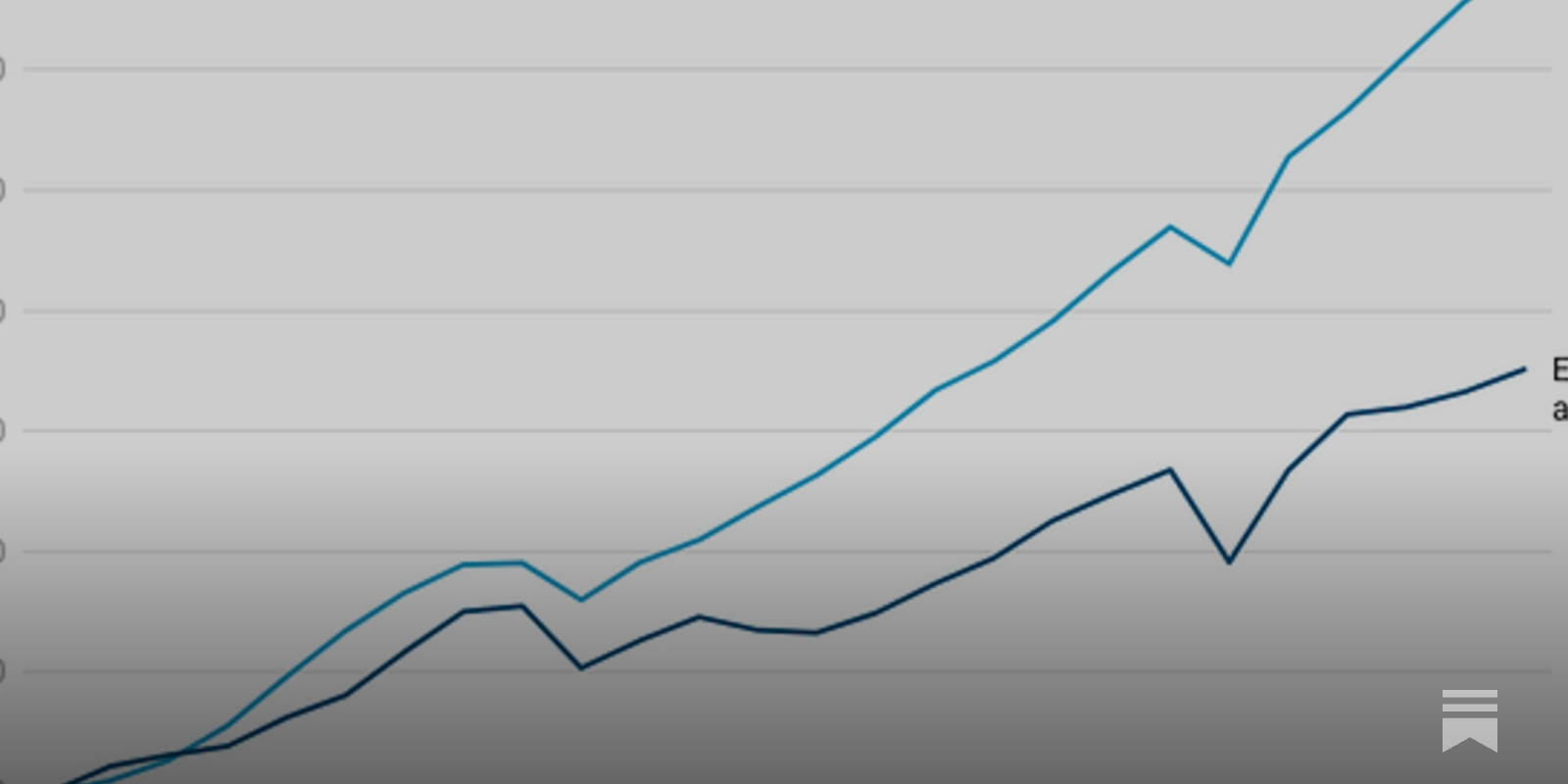
But a funny thing happened on the way to inexorable European decline: If one compares either European GDP per capita or European productivity (GDP per hour) with that of the US on a year by year basis, using completely standard methods, one does not find an ever-growing gap. In fact, the gap between Europe and America has, if anything, narrowed somewhat over the past 25 years.
Understanding Europe’s economic performance is of huge importance, not just for Europeans, but for the rest of the world. The stakes go beyond economics. With authoritarianism on the rise in America, Europe is now the world’s great bastion of democracy. Hence it is important that it maintain its standing as a counterbalance to the US and China. Furthermore, Europe’s economic performance relative to the U.S. is often cited as a data point in debates on economic and social policy. Thus it’s important to understand what that record actually shows.
Finally, wearing my professional economist hat, what I call the US-EU paradox is interesting. We have two ways of comparing major economies: one based on measured economic growth, one based on measured purchasing power. Both comparisons involve orthodox, widely accepted procedures. Both are carried out by eminently respectable statisticians and agencies. Yet they lead to starkly different conclusions. One says that Europe is in relative decline, while the other says it isn’t.
I was first alerted to this strange dissonance in a February 2026 post by Seth Ackerman. Since then I’ve been trying to make sense of the apparent contradiction.
Today’s post is a detour from my ongoing series on the implications of AI, which I plan to return to next week. Here I will offer a wonkish progress report on my recent efforts to unpack the US-EU paradox. I will argue that the preponderance of the evidence supports the view that Europe is not in relative decline. I will show that comparisons that seem to show Europe lagging ignore important qualifications – qualifications that can render those comparisons misleading. First, there is a big difference between the EU and the US in industrial mix: the U.S. economy is more highly concentrated than Europe in “tech”, which creates a divergence in measured growth but not in living standards. Second, it is inherently difficult to measure growth in the face of technological change – a problem that doesn’t arise, notably, when comparing economies at a given point in time.
Beyond the paywall I’ll address the following:
1. The US-EU paradox and why it matters
2. Dollars, PPP and Big Macs: Measuring purchasing power
3. Understanding the growth discrepancy 1: Industrial mix
4. Understanding the growth discrepancy 2: Measurement
5. What about consumption?
6. Lessons from the US-EU comparison
Source: paulkrugman.substack.com